Why Casa de SAM Is Building Homes, Not an Institution
Home and institution are not only descriptions of architecture. They describe how people are treated and how much of their own lives they are allowed to possess.
When I imagine my son Sam’s future, I do not begin with a program.
I begin with a home.
I imagine a bedroom that reflects his life rather than a room prepared for an anonymous “client.” I imagine people who recognize his sounds, understand his routines, and notice when a small change means something is wrong. I imagine familiar food, comfortable places to sit, room to move, and the freedom to have a quiet day without being pushed through activities simply because they appear on a schedule.
Sam will likely need substantial daily support throughout his adult life. He may always need help with communication, safety, personal care, medical decisions, transportation, and many ordinary parts of the day.
But needing extensive care does not mean he should spend his life in a clinical environment.
That distinction is central to the vision for Casa de SAM.
Casa de SAM is planning a larger residential community in Paraguay, but its residents would not live in one central facility divided into wings, units, or wards. They would live in small, family-style homes. Each home would have its own bedrooms, living areas, household rhythms, caregivers, and identity.
The larger property would provide resources, relationships, recreation, transportation, backup staff, and long-term stability. But the individual home would remain the center of each resident’s life.
A collection of small buildings, however, is not automatically better than one large building. A campus of attractive houses can still operate institutionally. A large residence can sometimes offer more warmth, choice, and respect than a poorly managed group home.
“Home” and “institution” are not only descriptions of architecture. They describe how people are treated and how much of their own lives they are allowed to possess.
What makes a setting institutional?
When people hear the word “institution,” they may picture a large, outdated facility with long hallways, shared sleeping rooms, locked doors, and rows of beds.
Those places have existed, and some still do. But institutional life is not defined only by the size or age of a building.
A residential setting can become institutional when:
- Everyone follows the same schedule regardless of individual needs.
- Staff convenience consistently takes priority over resident preference.
- Bedrooms appear temporary or interchangeable.
- Residents have little privacy.
- Food, drinks, movement, or relationships are unnecessarily controlled.
- Optional activities quietly become mandatory.
- Residents are moved without meaningful consideration of their attachments.
- Personal possessions are treated as clutter or risk rather than part of a person’s life.
- Staff know diagnoses and care plans but do not truly know the people.
- Rules apply to everyone because individual decision-making requires more work.
- A person’s entire life takes place inside one service system.
- Residents are treated as recipients of care rather than adults who belong there.
An institution organizes people around the needs of the system.
A home organizes support around the people who live there.
That does not mean a home has no rules, routines, supervision, or safety restrictions. Casa de SAM is intended for adults whose disabilities may make some forms of complete independence unsafe. Medication must be administered correctly. Personal care must happen. Staff shifts must be covered. Emergencies require plans. Housemates have rights too.
The goal is not to eliminate structure. It is to make sure structure serves residents rather than swallowing their lives.
Why Casa de SAM is planning multiple small homes
Casa de SAM’s current vision is for several small homes located within a larger residential community.
Each home would serve a limited number of residents—currently envisioned as approximately six to nine—and include private bedrooms, shared household living areas, a kitchen or kitchenette, and a dedicated or live-in caregiver.
That size is not a magic number. A six-person home can still feel institutional, while a somewhat larger household can sometimes feel deeply personal. The final design will require professional input, staffing analysis, financial planning, and experience with the individual residents.
The purpose of the smaller household is to make it possible for residents to be known.
In a smaller home, caregivers can learn who wakes early, who needs silence in the morning, who becomes anxious before a storm, who likes to sit near the kitchen, who needs movement before bed, and who communicates discomfort through a change most people would miss.
Household life can develop its own personality. One home may be lively and social. Another may be quieter. One may include residents who enjoy frequent outings. Another may need a slower rhythm and more sensory calm.
Residents should not be grouped together only because they share a diagnosis. Housemate compatibility, communication styles, sensory needs, sleep patterns, medical requirements, personalities, and support needs all matter.
The larger Casa de SAM community would provide shared strength. The smaller home would provide familiarity.
A private bedroom is more than a bed
Every Casa de SAM resident is currently envisioned as having a private bedroom.
Privacy matters for any adult, including an adult who cannot live independently or reliably communicate the desire to be alone.
A resident’s bedroom should not look like a generic room waiting for its next occupant. It should hold evidence of that person’s life: photographs, favorite colors, familiar blankets, meaningful objects, preferred lighting, sensory items, books, music, faith materials, collections, artwork, and furniture selected for the individual.
For some residents, the room may need durable materials, discreet alert systems, accessible plumbing, caregiver access, space for medical equipment, or safety features related to seizures, falls, elopement, or self-injury.
Those protections should be incorporated as quietly as possible.
The purpose is not to make residents feel watched. It is to create a bedroom capable of remaining theirs as their bodies, health, and support needs change.
Choosing and preparing the room should be part of a resident’s transition into Casa de SAM. The resident is not being assigned an available bed. They are entering a long-term home.
Home includes access to ordinary comforts
Institutions often control ordinary life through access.
A person may need permission to get a snack, use a preferred room, go outside, call someone, change an activity, or stay awake beyond a scheduled bedtime. Sometimes those limits are necessary for an individual’s safety. Too often, they exist because one rule is easier to administer than many individualized decisions.
Casa de SAM should plan for adult life as it is actually lived.
Residents may wake up thirsty. They may be hungry at unusual times. Some may need routine snacks for medication, blood sugar, sensory regulation, comfort, or simple preference. Each home should therefore have its own kitchen or kitchenette rather than making residents dependent on a central dining facility for every drink, snack, and familiar food.
There may be shared household rhythms for meals, bathing support, medication, appointments, transportation, quiet hours, and staffing. But not every resident needs to wake, eat, bathe, play, rest, or sleep at the same time.
Adults do not need institutional bedtimes. Homes still need quiet and safety.
That balance will not always be simple. One resident’s late-night movement may disturb a housemate. Unrestricted food access may be unsafe for someone with allergies, swallowing difficulties, diabetes, or a compulsion involving food. An exterior door may require an alarm because a resident is at risk of elopement.
Individualized support does not mean pretending risks do not exist. It means addressing the actual risk without unnecessarily restricting everyone else.
Residents should not have to perform a program
Casa de SAM may eventually include gardens, animals, walking paths, recreation, a bakery, a water park, community events, visiting professionals, and other shared spaces.
Those features could offer residents enjoyable places to go, familiar people to see, and meaningful ways to participate in the wider community.
Participation must remain optional.
A resident should not be required to attend a class, complete a therapy activity, work in the bakery, care for animals, greet visitors, or join a group outing simply because Casa de SAM offers it.
Some residents may love helping with bread, carrying supplies, watering plants, or spending time near customers. Others may want nothing to do with any of it. Some may enjoy watching an activity without participating. Some may repeat the same preferred task without progressing toward a conventional skill or employment goal.
Residents do not have to become productive enough to justify their care.
Their home is not payment for labor, public participation, good behavior, inspiring progress, or cooperation with a program. It is where they belong.
Caregivers help determine whether a house feels like home
Architecture matters, but caregivers will create much of the actual experience.
A beautifully designed house can become cold and controlling if it has constant staff turnover, hurried personal care, rigid rules, or employees who see residents only as tasks to complete.
Casa de SAM’s current vision includes at least one deeply invested, long-term caregiver connected to each home. That person may be a live-in caregiver, senior house caregiver, or, in some cases, a qualified family member of a resident.
The goal is continuity.
Someone in the home should know more than what the care plan says. They should know which cup a resident always chooses, which song helps during a difficult transition, which movements signal pain, which foods are tolerated only in a particular form, and when an unusual silence deserves immediate attention.
Family caregivers may bring years of irreplaceable knowledge. When a qualified, stable, mission-aligned family member wants to serve in a house, that should be treated as a potential strength.
But family connection cannot replace training, oversight, boundaries, backup staffing, or accountability. A caregiver cannot control a home for the benefit of their own relative. The presence of one devoted person should strengthen care for every resident in the household.
The mature Casa de SAM model also cannot depend entirely on families continuing to sacrifice indefinitely. Part of the reason for building this community is that parents age, become ill, and die. The organization must be strong enough to continue when the original family caregiver is no longer there.
Permanence changes the meaning of care
Many disability services are built around temporary placements, changing eligibility, annual funding decisions, or a person’s ability to remain within a particular level of need.
Families may be told that a placement is appropriate now but not receive a clear answer about what happens if the resident develops seizures, dementia, reduced mobility, swallowing problems, or more intensive overnight needs.
Casa de SAM is being envisioned as a lifelong home.
That promise has implications far beyond compassionate language. Homes must be designed for aging and changing bodies. Medical support must be able to expand. Funding must be protected across decades. Care cannot depend on one founder, one donor, one caregiver, or one unusually successful revenue stream.
If a resident eventually needs to move from one Casa de SAM house to another because of medical needs or housemate compatibility, the transition should preserve as much familiarity as possible. The resident should remain connected to known people, places, routines, and the larger community.
A lifelong home should not become disposable when care becomes harder.
Safety should be built in without dominating the home
Some Casa de SAM residents may be vulnerable to elopement, falls, seizures, choking, exploitation, self-injury, abuse, or medical emergencies. Some may be unable to call for help or explain what happened.
Those realities cannot be minimized in an effort to make the setting appear more independent.
Homes may need discreet door and window alarms, secure outdoor areas, durable fixtures, careful bathroom design, overnight supervision, communication supports, emergency access, and technology that alerts caregivers without making the environment feel like a surveillance facility.
Staff must also be screened, trained, supervised, and held accountable. Volunteers should never substitute for qualified staff or be left alone with residents simply because their intentions are good.
The physical environment is only one layer of protection. Policies, documentation, outside oversight, family communication, complaint procedures, financial controls, and a culture that takes small concerns seriously are equally important.
“Home” must never become an excuse for informality where resident safety is concerned.
The aspiration is rigorous care in a humane setting.
A larger campus creates both opportunities and risks
Casa de SAM is not planning isolated houses scattered across unrelated neighborhoods. It is planning homes within a larger property.
That offers potential advantages. Staff and emergency support can be nearby. Transportation and maintenance can be shared. Residents may have more places to walk safely, more familiar people to know, and more options beyond the preferences of their immediate housemates.
A resident who cannot independently navigate busy streets might still enjoy meaningful freedom within a protected property. Someone overwhelmed by unfamiliar public places might participate in a garden, bakery, animal area, chapel gathering, or recreation space without every experience requiring a difficult trip.
But the same campus could become a closed world.
If residents rarely leave, have no relationships beyond the organization, are expected to participate in Casa de SAM activities, or are displayed to customers and donors, the community could become exactly what we are trying to avoid.
The public-facing parts of Casa de SAM must support the residents without taking possession of their lives.
Customers, volunteers, professionals, churches, and visitors may be welcomed into appropriate areas. Resident homes should remain private. Sam and the other residents must never become attractions, marketing props, or proof that the organization deserves money.
The wider community should bring more life to residents—not more access to them.
A photograph about care, faith, and being known
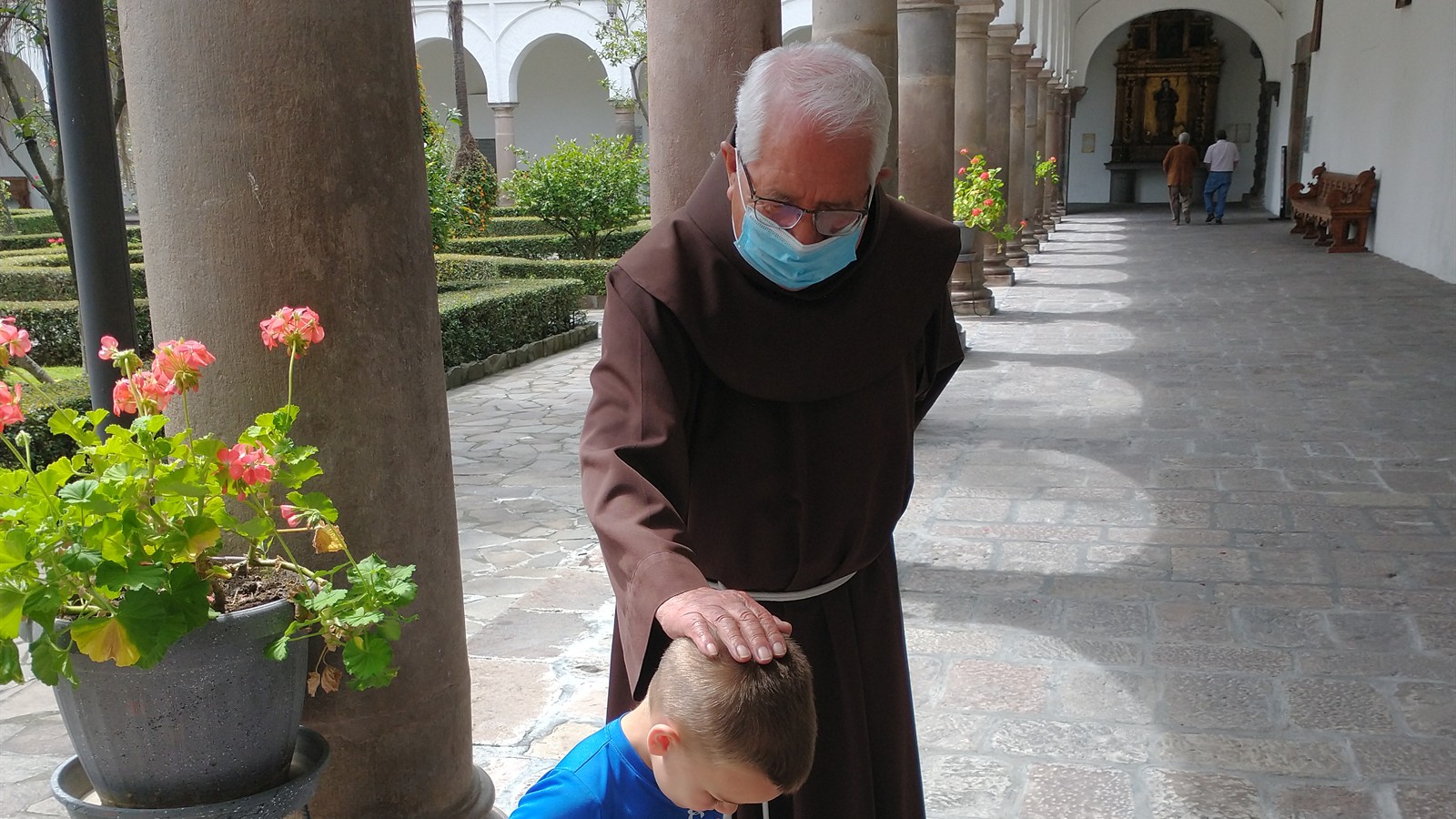
The photograph accompanying this article shows Sam with a Franciscan friar in Quito, Ecuador.
It is a small moment from the years when Sam and I were exploring South America together. The friar placed his hand gently on Sam’s head, and Sam stood there in his own distinctive way.
When I look at this picture now, I think about how much care depends on a person being received as they are.
Sam does not need to speak, perform, or explain himself in order to be worthy of tenderness. He does not have to understand every interaction in the same way the adults around him understand it. He is fully present, fully human, and fully deserving of a place where people recognize that.
That is the kind of home I want Casa de SAM to become.
How will we know whether the homes are still homes?
Good intentions at the beginning will not be enough.
Organizations change. Founders leave. Staff turn over. Financial pressure grows. A rule introduced for one understandable reason can gradually become a restriction applied to everyone. An efficient system can quietly replace an individualized one.
Casa de SAM will need to keep asking practical questions:
- Do bedrooms still reflect the people living in them?
- Are residents making meaningful choices wherever they safely can?
- Are restrictions individualized, documented, and reviewed?
- Can residents decline optional activities?
- Can they rest without being treated as uncooperative?
- Do caregivers know residents beyond their diagnoses?
- Are families welcomed without being allowed to dominate the home?
- Can residents maintain relationships outside Casa de SAM?
- Does the organization adapt when needs change?
- Are complaints heard by someone with the power to act?
- Are staff supported well enough to provide patient, humane care?
- Is growth improving resident life or placing it under strain?
- Are financial activities serving the homes, or are the homes beginning to serve the financial activities?
The institution Casa de SAM must guard against is not only a particular type of building.
It is the gradual replacement of people with systems.
What you can do this week
You do not need to know exactly where your loved one will live to begin identifying what would make a future residence feel like home. This week, start building a wishlist of the ordinary comforts, personal choices, safety supports, and familiar routines you would want a future provider to understand and preserve.
Photograph their room as it is today
Notice the objects, colors, arrangements, and familiar items that communicate identity or provide comfort.
Write down five ordinary household preferences
Include details such as waking time, preferred cup, lighting, favorite chair, snack routine, music, bathing preference, or need for quiet.
Identify one rule that would create unnecessary hardship
Consider what might happen in a setting with fixed mealtimes, mandatory activities, limited food access, shared bedrooms, or standardized sleep schedules.
List the safety supports that could be built in quietly
These might include window alarms, enclosed outdoor space, accessible bathrooms, seizure monitoring, visual communication, durable materials, or overnight supervision.
Ask one future provider a home question rather than a service question
Instead of asking only, “What services do you offer?” ask, “How does a resident make this place their own?”
Long-term questions to consider
- What makes my family member recognize a place as home?
- Which routines provide comfort, and which can change?
- How does the person communicate a desire for privacy, company, food, rest, movement, or help?
- What personal possessions and family memories must move with them?
- What safety features will they need now and as they age?
- Can a provider continue supporting them if their medical or mobility needs increase?
- Who will preserve the person’s story when their current caregivers are gone?
- How will new staff learn the small details that are not captured in formal records?
- Can the resident maintain family, faith, cultural, and community relationships?
- What happens when a house rule conflicts with an individual need?
- Who reviews restrictions and advocates for a resident who cannot complain verbally?
- What prevents financial pressure or organizational growth from eroding the quality of home life?
- If leadership changes, which protections will remain enforceable?
- Will this still feel like the resident’s home when no one from the founding generation is there?
Casa de SAM is still a developing vision
Casa de SAM is not yet an operating nonprofit, residential provider, or available placement.
The current plan will require land, funding, legal work in Paraguay and the United States, a qualified board, professional design, experienced disability-care leadership, trained staff, outside oversight, and years of careful development.
Some details will change as experts, future board members, families, and eventually residents help shape the model. Calling the buildings “homes” now does not guarantee that we will succeed in creating them.
That is why these principles must be documented before the buildings exist.
Casa de SAM is not trying to make substantial disability disappear behind attractive architecture. Residents will need real care, and sometimes that care will be intensive. The goal is to provide it without asking people to surrender their identity, privacy, history, comfort, or adulthood in return.
Sam may always need someone nearby.
He may always need another person to notice, interpret, protect, prepare, prompt, and help.
But he should still have a front door he comes home through, a bedroom that tells his story, familiar people waiting inside, and a place in the household that cannot be reduced to an available bed.
That is why Casa de SAM is building homes.
Sources and further reading
- Medicaid.gov: Home and Community-Based Services Final Regulation
- Administration for Community Living: About Community Living
- U.S. Department of Justice: Olmstead and Community Integration
- Centers for Medicare & Medicaid Services: Home- and Community-Based Services
About Casa de SAM
Casa de SAM is a developing vision for a lifelong residential community in Paraguay for adults with autism and other developmental disabilities who need substantial daily support. The project is being built around one central promise: residents should be safe, known, respected, and able to belong without having to earn their place through productivity or independence.
Casa de SAM is not yet an operating nonprofit or residential provider. We are currently researching, documenting the vision, and looking for people who may eventually help build it responsibly.
This article describes Casa de SAM’s developing philosophy and plans. It is not medical, legal, financial, or placement advice. The final residential model will require professional, legal, clinical, architectural, and regulatory review.